The company grew paying users from 13 million in 2019, to a peak of 18.22 million in FY24. That trend has since started to reverse with paying users sitting at 18.08 million users today.
That reversal spooked markets, and Dropbox trades as though the bulk of its paying base is on its way out the door.
The cloud storage market is high margin but brutally competitive, and many will point to Google Drive, iCloud, and OneDrive as evidence Dropbox doesn't need to exist. It's a fair argument, but a surface level one. If that thesis were true, you'd expect Dropbox to have bled users steadily for the better part of a decade as the hyper scalers bundled "good enough" storage into products people already pay for.
Instead, paying users grew for five consecutive years, adding more than 5 million subscribers between 2019 and 2024, before the recent, comparatively modest pullback. That's not the shape of a company being rendered obsolete. It's the shape of a company that rode a real secular tailwind (the shift to distributed work) and is now navigating that tailwind's end.
To me, that history says a neutral, non OS specific cloud layer is not only valuable, it plays a genuine role in the ecosystem. The open question isn't whether Dropbox can exist. It's what kind of company it is once the growth runway is gone.
Where the Real Engine Is: Free Cash Flow Into Buybacks:
I won't kid myself: the days of even moderate top line growth are likely behind Dropbox. My base case (including moderate success in monetizing even a fraction of their user base further with Dash (more info on this later)), revenue growth is likely to be in the low single digit range.But there's a second engine sitting underneath the revenue story that does most of the actual work in this thesis, and it deserves its own section before we even get to Dash.
Dropbox generates roughly $940–950 million in free cash flow annually, on a business with minimal capital intensity (capex is a rounding error, under $25M/year).
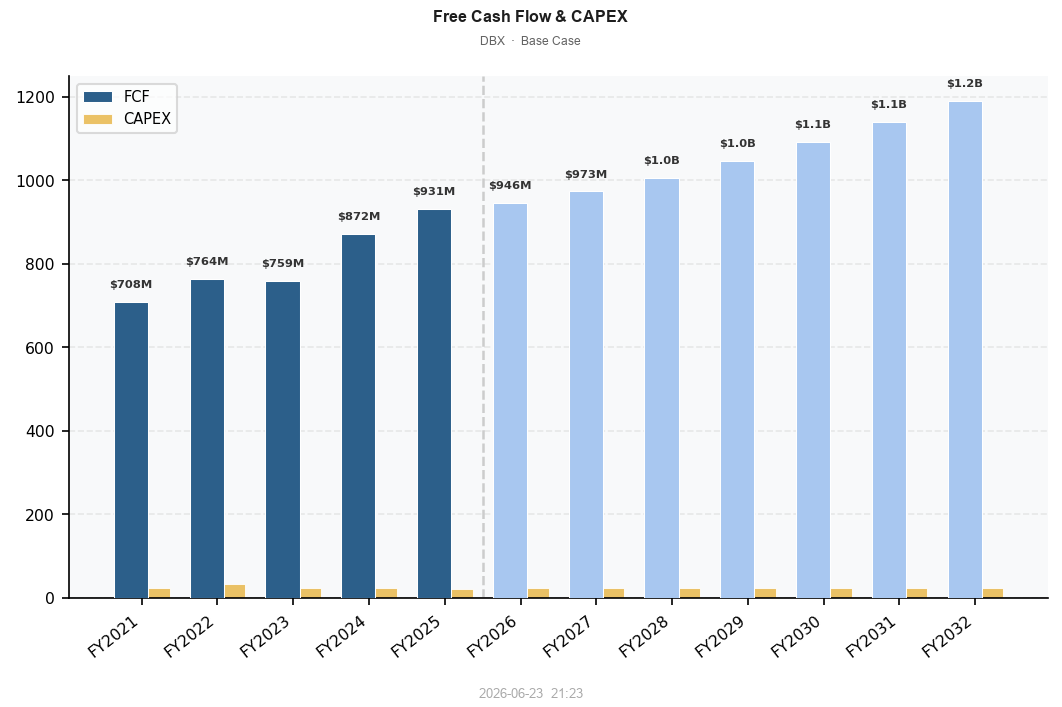
Management has been extraordinarily aggressive about what it does with that cash:** shares outstanding fell by roughly 15% in the last year alone**, and the company just authorized an additional $900 million buyback program in June 2026, backed by a new credit facility.
Here's the detail that matters most: Dropbox's buyback spend now exceeds its annual free cash flow. Recent quarters have run $260–415 million in repurchases each, annualizing to well above the $940–950M FCF base. The gap is being funded by debt, not by other cuts to the business. That's worth sitting with rather than glossing over. It's a meaningfully more aggressive pace than other companies with aggressive buybacks in place like PayPal, a company with a similar capital return playbook, which has consistently retired shares at an 6–8% annual rate funded entirely by free cash flow, with no added leverage.
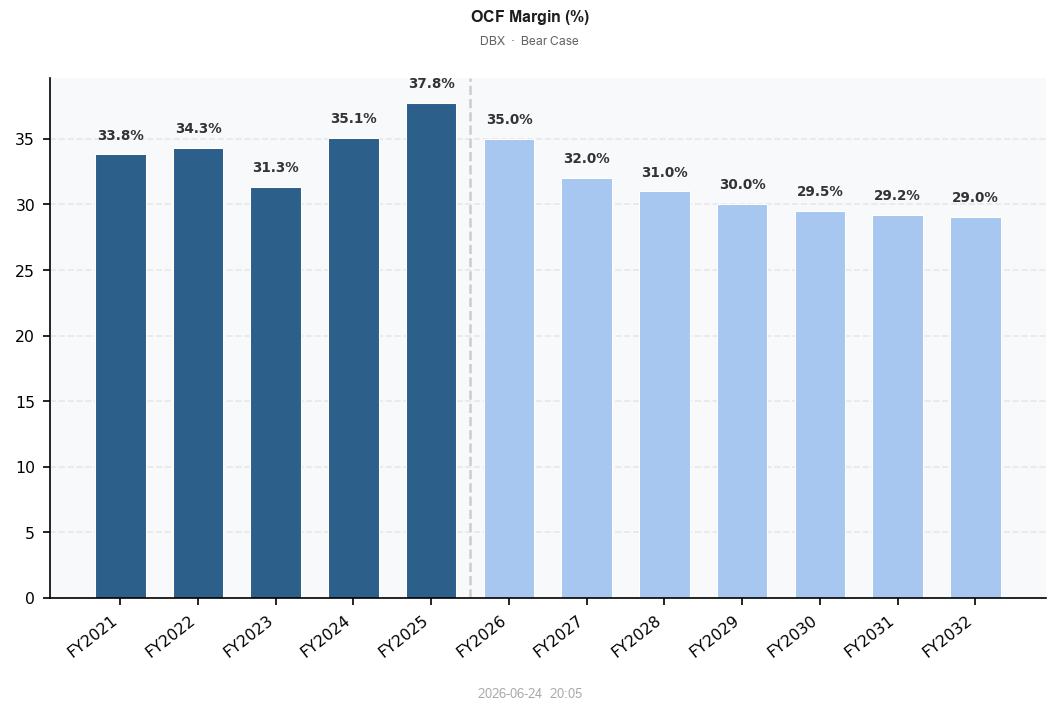
Is that a Bed Bath & Beyond setup? I don't think so, and the distinction matters. BBBY borrowed to buy back stock from a shrinking, structurally broken cash flow base. Declining sales, eroding margins, no plan. Dropbox is borrowing on top of a stable, still strong FCF base, with operating cash flow margins holding in the high-30s percent. The debt isn't propping up a melting business; it's accelerating the retirement of a share count that management evidently believes is mispriced. If you think the stock is genuinely cheap (and I personally do), borrowing to buy more of it while it's cheap is a defensible use of the balance sheet (if you are borrowing on the back of a stable cash flow basis). The real risk isn't insolvency. Current FCF services this debt load comfortably. The real risk is whether the core business erodes before Drop Box is able to add further value to stem those losses.
What Dropbox Is Worth Without Dash:
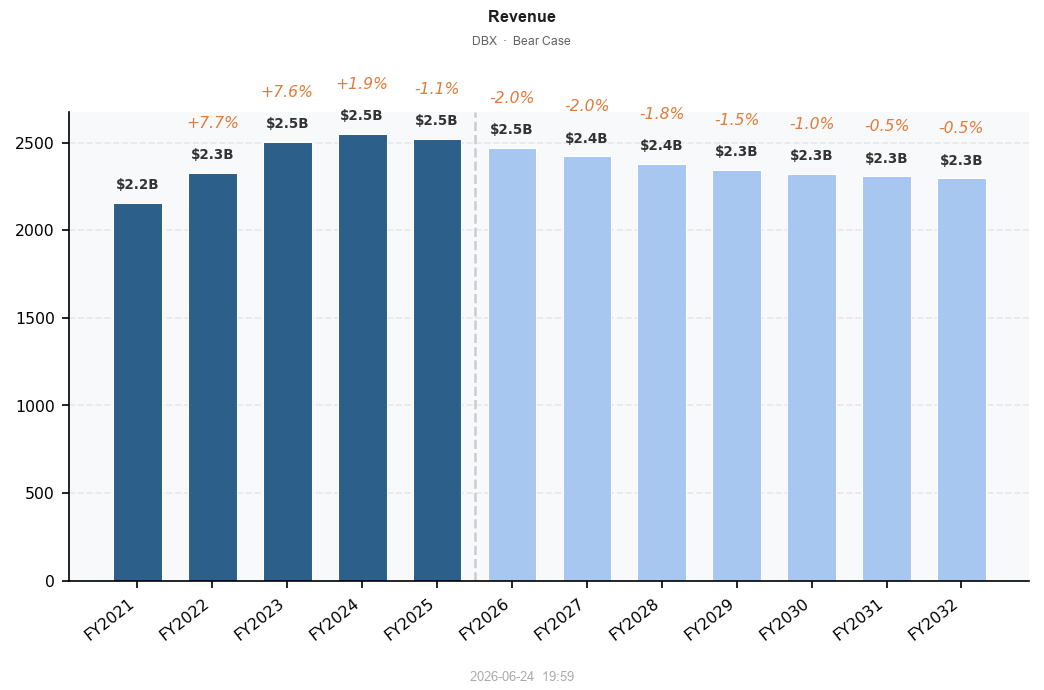
Before getting to the part of this story everyone wants to talk about, it's worth establishing the floor: what is Dropbox worth assuming Dash contributes nothing at all?Without Dash (or an alternative to increase their value), I would expect revenue to continue fall as more users make the switch to bundled alternatives.
Margins would likely start to compress on a lower revenue base and a continued race to the bottom on prices.
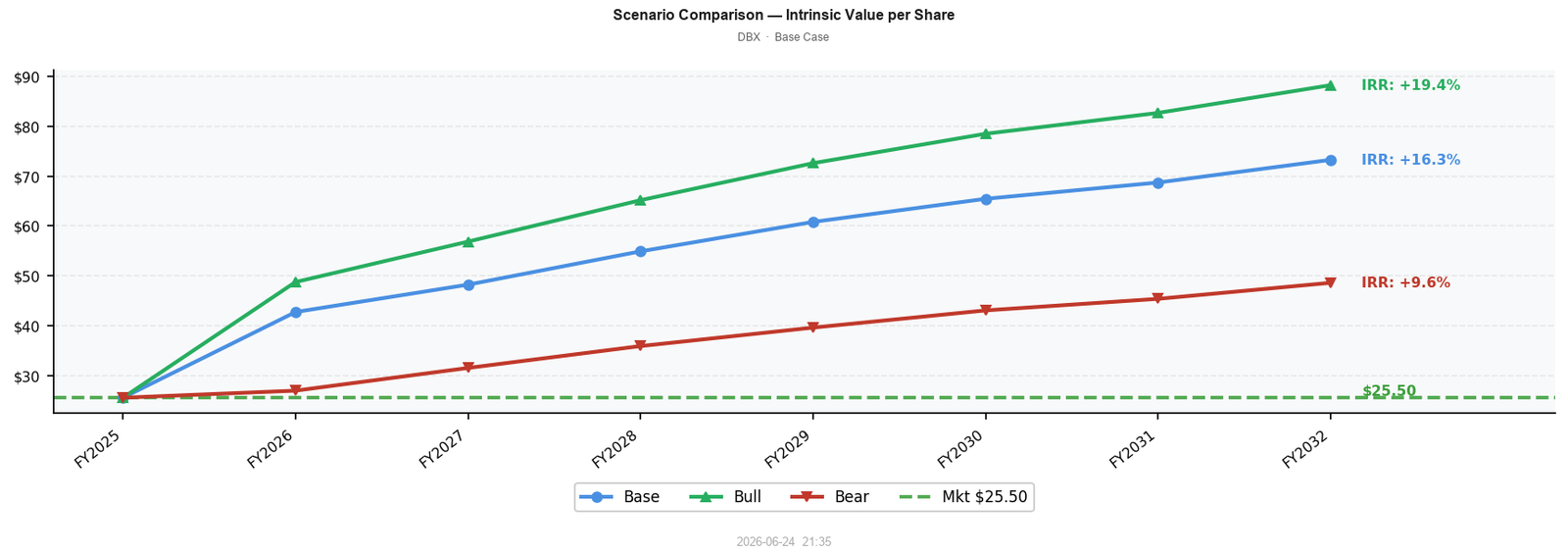
And finally, I utilized my standard 10% discount rate in combination with a lower Terminal growth rate of 1% to arrive at a business that is roughly fairly valued today, but that generates a 9% IRR over the next 7 years.
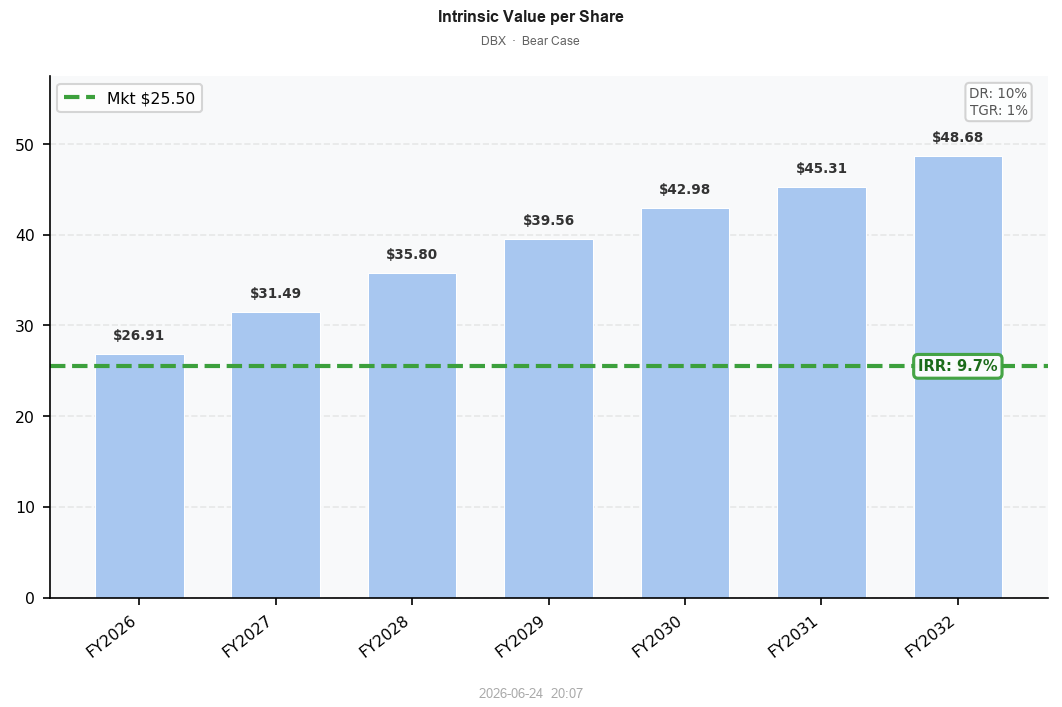
Our margin of safety if everything goes wrong, is a business that can still generate an attractive return based on their operations.
The above is my bear case scenario and not what I personally believe to be likely, but worth understanding.
Enter Dash:
Dash is Dropbox's AI-powered search and work-organization tool. it lets users find and act on content across all their connected apps and cloud storage, not just Dropbox itself.To generate significant new user growth, Dash would have to be better than everything already out there (Microsoft Copilot, Google Gemini, Glean, and a crowded field of well funded competitors).
That's unlikely, and I'm not underwriting it. But to monetize the existing user base, Dash doesn't need to win that fight. It just needs to be competent at what it does. If it stays in its lane and proves genuinely useful to Dropbox's existing customers, only a fraction of that 18-million-user base needs to adopt it to push DBX's top line back into low-single-digit growth over the next few years.
At present, Dash is priced as a standalone $20/month product. if we assume a 50% discount in bundling, **even a 2% monetization of their entire user base **(or roughly 6%-8% of their estimated small business / enterprise customers (Team/Business/Enterprise plans - estimated at 35% to 45% of the business - these customers are far more likely to adopt Dash)) allows the company to return to low single digit growth.
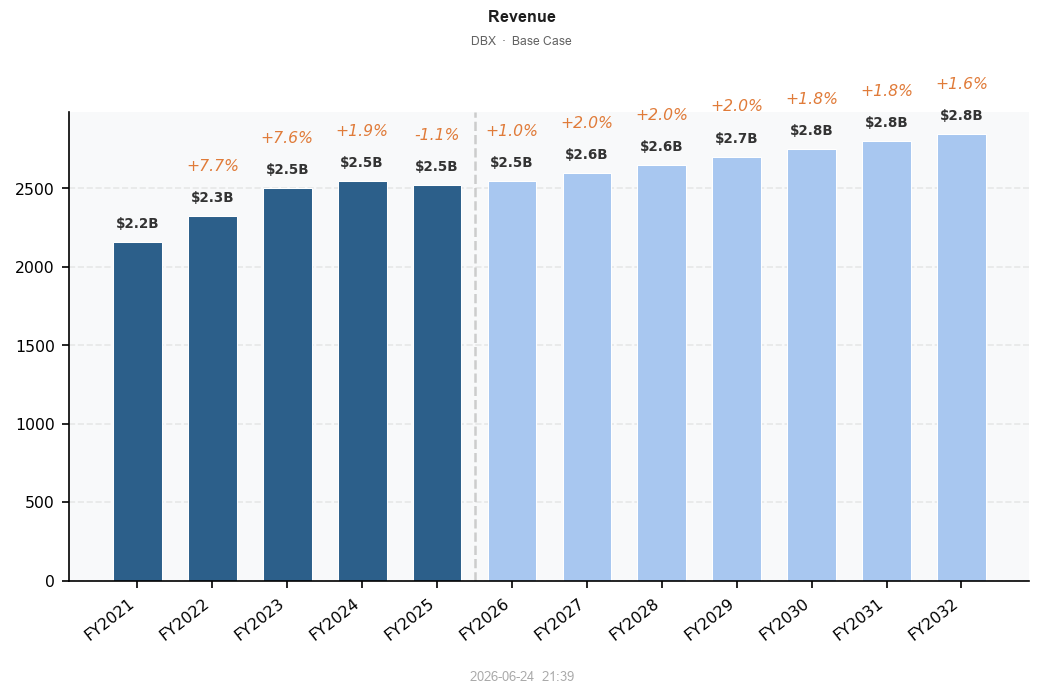
Early signals are mixed but not discouraging: repeat usage among people who try Dash has been solid (more than 30% weekly repeat usage, over 50% monthly), though adoption so far is concentrated almost entirely within the existing customer base rather than pulling in new customers (which is consistent with the retention framing above). Management itself has been careful not to credit Dash for recent guidance improvements, attributing those instead to core-business execution. That's the right amount of caution to bring to this part of the thesis: it's a real call option, not a sure thing, and the existing math doesn't depend on it paying off.
Putting It Together:
If Dropbox can continue stemming the paying user losses (and the last two quarters suggest it already has) hold operating cash flow margins roughly flat, and convince even a modest slice of its 18 million paying users to add Dash to their bill, I calculate the stock to be roughly 33% below FY26 intrinsic value (at a current market price of $25.50), with an IRR over 16% over the next seven years, substantially bolstered by an aggressive buyback program running in the low double digits (tapering to mid single) annually.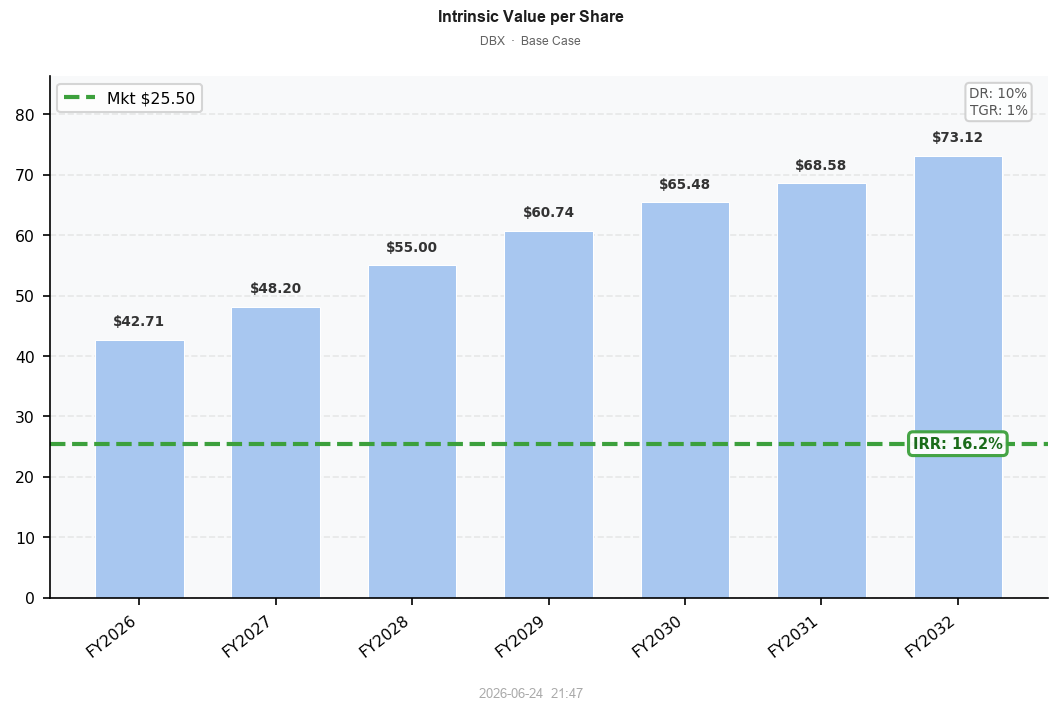
The thesis doesn't require Dropbox to become a growth company again. It requires the bleeding to slow/stop, the cash flow to hold, and management to keep doing what it's already doing: retiring shares aggressively while the stock is cheap. Dash is the upside case on top of that, not the foundation underneath it.
Dropbox isn't a company I would personally allocate large percentages of my portfolio to, but I have initiated a very small sleeve (mostly reallocating dividends from other companies).
As always, please remember that this is not financial advice, my own personal opinions, and that you need to do your own research.