Value investment, or Value trap?
I came across Celsius Holdings while browsing the value investing subreddit, where someone asked whether CELH represented the epitome of a classic value investment... strong historical growth paired with a stock price that has fallen 45% over the past year.Celsius is a maker of "healthy" sugar free energy drinks. They went from a niche fitness brand to a serious competitor with the 3rd largest market share (after Monster and Red Bull) in the space over the span of a few years. Celsius may not be a household name yet, but you definitely see their products on store shelves (especially after Pepsi agreed to expand their products to more stores via their distribution system). To add context to the breadth of the brand; on top of their sugar free Celsius energy drinks, they also own the rights to Rockstar energy in North America.
The investment thesis is one of growth riding the backs of the broader wellness consumer movement. After doing a deep dive into the company, my argument is not that Celsius is not a good brand (I believe it is so), it is that at the current price (even after falling 45%), the required growth and margin expansion to make CELH a quality investment able to generate a sufficient rate of return is unlikely. This is especially true in a market that is heating up with more competition from the likes of Kirkland (Costco) of which Celsius derives about 10% of their revenue.
This (in my opinion) is a great example of how a great company doesn't equate to a great investment, and just because the market price has fallen a significant amount, it does not equate to the company trading below intrinsic value.
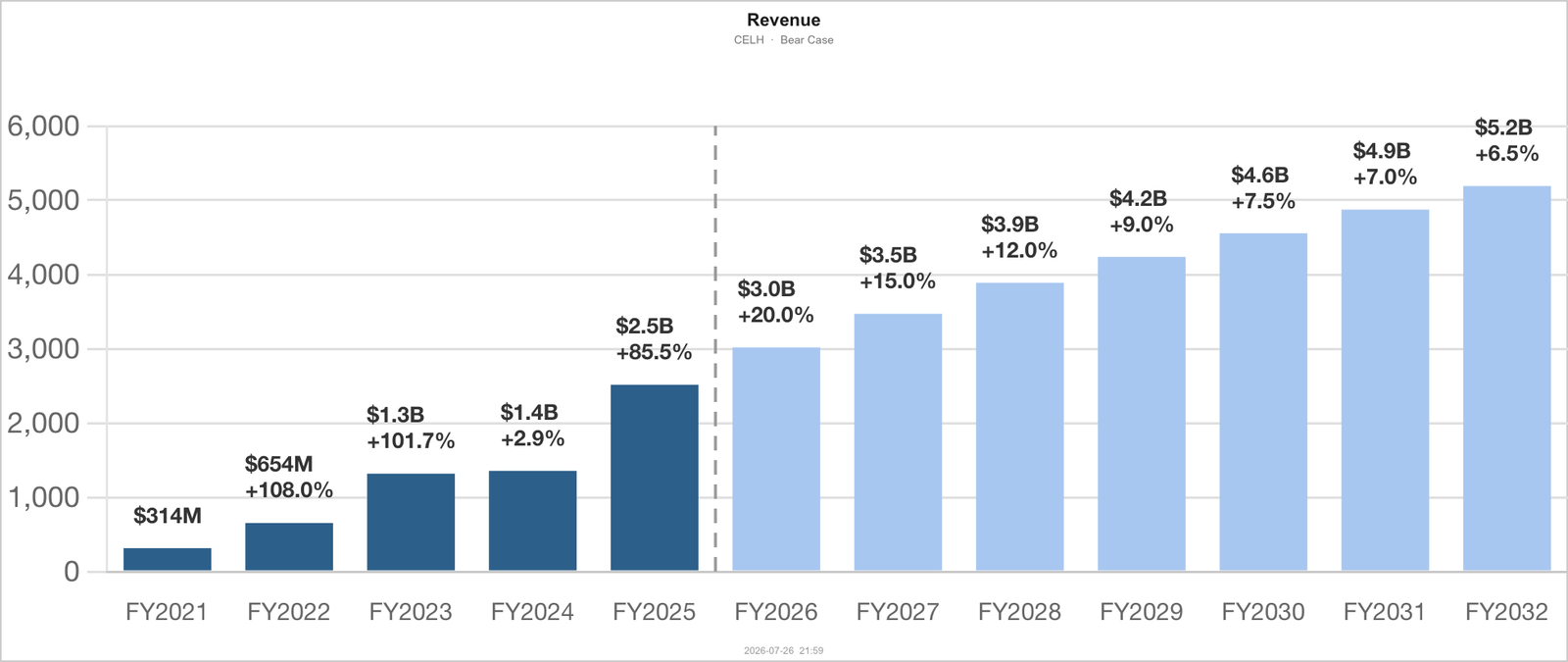
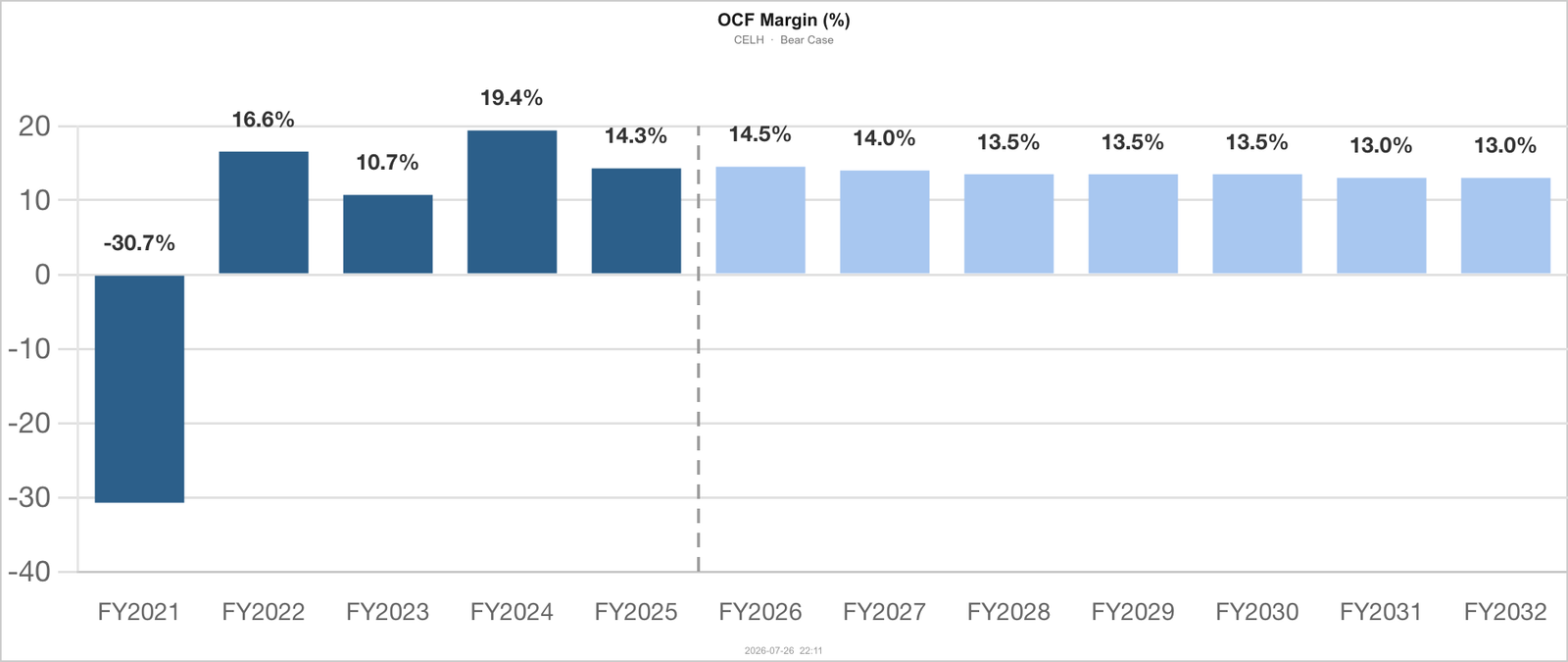
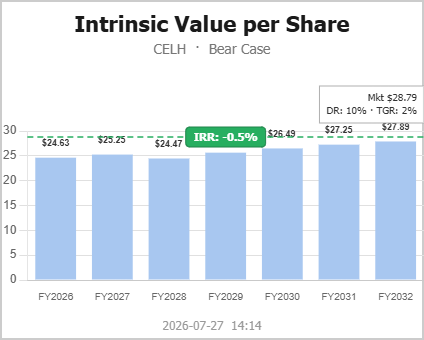
In this scenario, the market was priced for extended linear growth. the stock has fallen significantly but still remains about 15% above intrinsic value. There is of course, a scenario where my base case scenario assumptions come to fruition, but I personally lean more towards the bear thesis on this one. At $28.55, I am uninterested, but will continue to watch how this story unfolds.
If the market price falls closer to $18/share, that's where I might find myself wanting to initiate a position.
This (in my opinion) is a great example of how a great company doesn't equate to a great investment, and just because the market price has fallen a significant amount, it does not equate to the company trading below intrinsic value.
Valuation is both art and science.
My initial DCF (using my standard framework of stabilizing margins and tapering growth) suggested the stock could deliver close to a 20% IRR over seven years. But that’s the science of value investing: enter assumptions, get an output. The art is determining whether those assumptions make sense.
Celsius is a great company with a strong brand, but as mentioned, a falling stock price doesn’t automatically create an attractive entry point. Prior to the decline, the market was thinking linearly and pricing in 50%+ growth, consistent with the last few years. Going forward this just doesn't seem likely.
At $2.5bn it’s difficult to continue growing at this rate. Especially when the industry itself is only growing at a CAGR of about 6.50%¹ and competition is intensifying.
Growth & Margins
In my updated base case scenario, I price in expected revenue growth for FY26 at about 25% and tapered that down to high single digits by FY32 (with OCF margins that shift upwards from their recent lows). This led to the stock looking fairly valued but not yet at a price I would personally invest. However, in my opinion, the more likely trajectory is from my bear case which starts at 20% growth this year and tapers to mid high single digits by FY32.
The next core question is what to expect from operating cash flow margins. In my base scenario, I have built in a slight recovery up to 15%. However it’s plausible that with Costco entering their field (and the reliance on Costco as a primary distribution center) we could see these compress even further.
Valuation
If the above scenario comes to pass, we could be looking at a company that still looks expensive, even after a 45% decline. In my opinion, the growth story hasn't disappeared, but its no longer linear and in my experience this is where the market typically gets things wrong. When a company is in a hyper growth phase (think internet based businesses during the pandemic), analysts price in linear growth to the terminal value. the opposite is true for companies going through a temporary turnaround (analysts will price in low growth and compressed margins indefinitely (think intel from 2022). The answer (and the best risk adjusted returns) usually lie somewhere in the middle.
In this scenario, the market was priced for extended linear growth. the stock has fallen significantly but still remains about 15% above intrinsic value. There is of course, a scenario where my base case scenario assumptions come to fruition, but I personally lean more towards the bear thesis on this one. At $28.55, I am uninterested, but will continue to watch how this story unfolds.
If the market price falls closer to $18/share, that's where I might find myself wanting to initiate a position.
As always... this is not Financial advice. Please do your own research!