Value in Robotics:
Robotics is shaping up to be one of the more interesting multi decade investment themes I've been digging into this year, and Intuitive Surgical keeps coming up as one name with the a strong claim to being investable today rather than a speculative story. Robotics investing has a real problem... most companies chasing “the robotics theme” don't have the much operating history, cash flow, or transparency to build credible DCF assumptions on. They're either research projects, or hype vehicles trading on a narrative. Intuitive Surgical isn't any of those. It's been shipping robotic surgical systems since 2000, has a 25 year operating history, and most importantly... they generate the kind of durable, growing free cash flow I prefer my models to be built on.
That's the starting point for this thesis. Of the robotics names I shortlisted, ISRG is the one I keep coming back to as best positioned for the theme. This is a first pass and I'll keep refining the model as I dig deeper.
The Business - Two platforms, One Flywheel:
Da Vinci and ion... One being the mature cash cow, and the other being the new innovative growth lever, both building on the razor/blade business model that Intuitive has been running for the better part of 25 years.

da Vinci systems are sold outright, but for capital constrained hospitals it also places them under lease and usage based arrangements. They then earn high margin, recurring revenue from the instruments, accessories, and service contracts every procedure consumes. That recurring engine really is the bulk of the business. In FY2025, Instruments & Accessories made up roughly 60% of revenue and Service another 15%, versus about 25% from system sales. So a large majority of revenue tracks procedure volume on the existing installed base, not how many new systems get sold in any given quarter.
Da Vinci Multi port - the core volume driver:
The original, general purpose surgical robot. A surgeon operates from a console a few feet away, directing wristed instruments through several small incisions for procedures spanning urology, gynecology, general surgery (hernia repair, colorectal), and more.
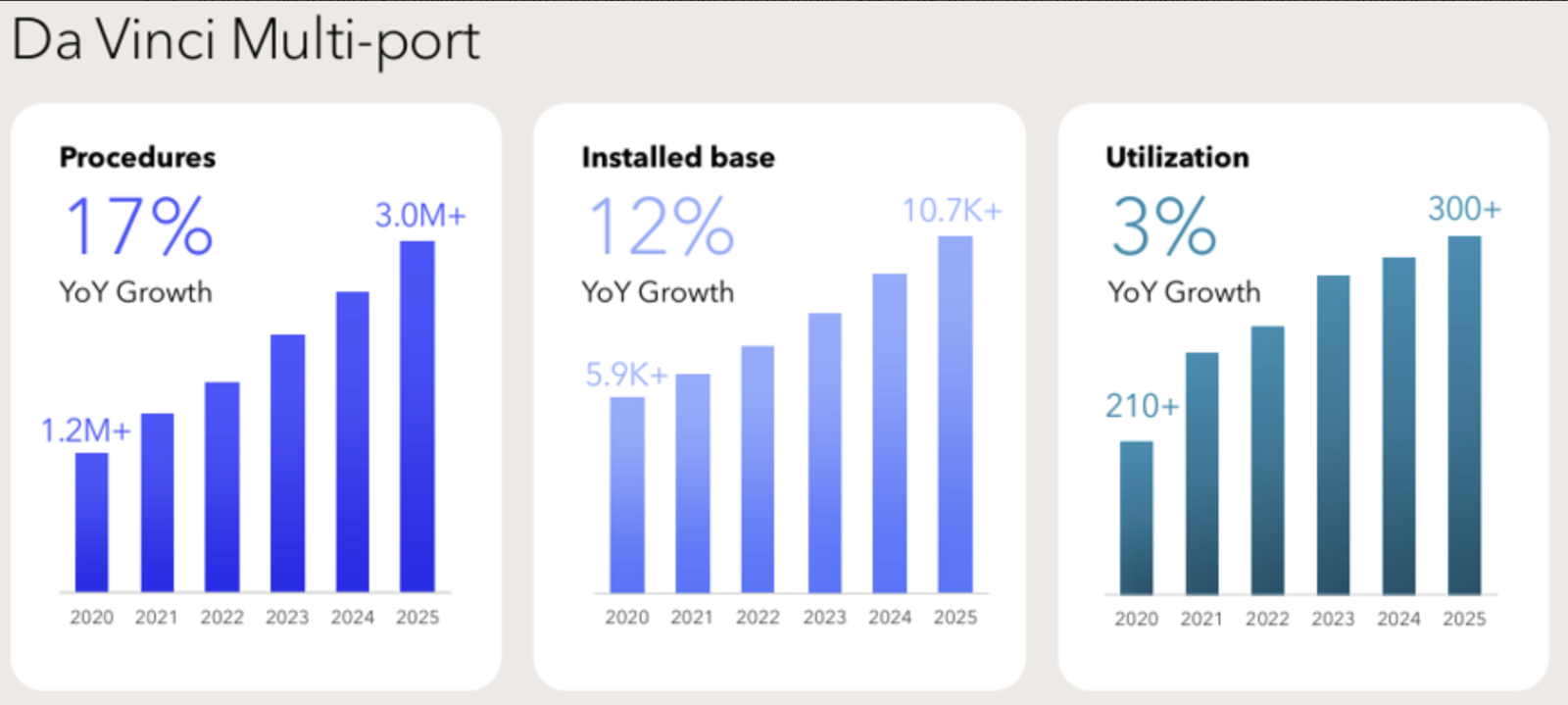
It's still the install base workhorse and the platform the whole recurring revenue engine is built on. Looking past any single year, procedures have compounded at roughly 20% a year since 2020 (1.2M to over 3.0 million in 2025), the installed base at roughly 13% (5.9K to 10,700), and utilization per system at a steadier 7% per year (210 to 300). This is the flywheel effect of more systems driving more procedures driving more utilization. Just at a more moderate, mature platform pace than the newer platforms below.
Da Vinci 5 - the newer, more interesting growth vector:
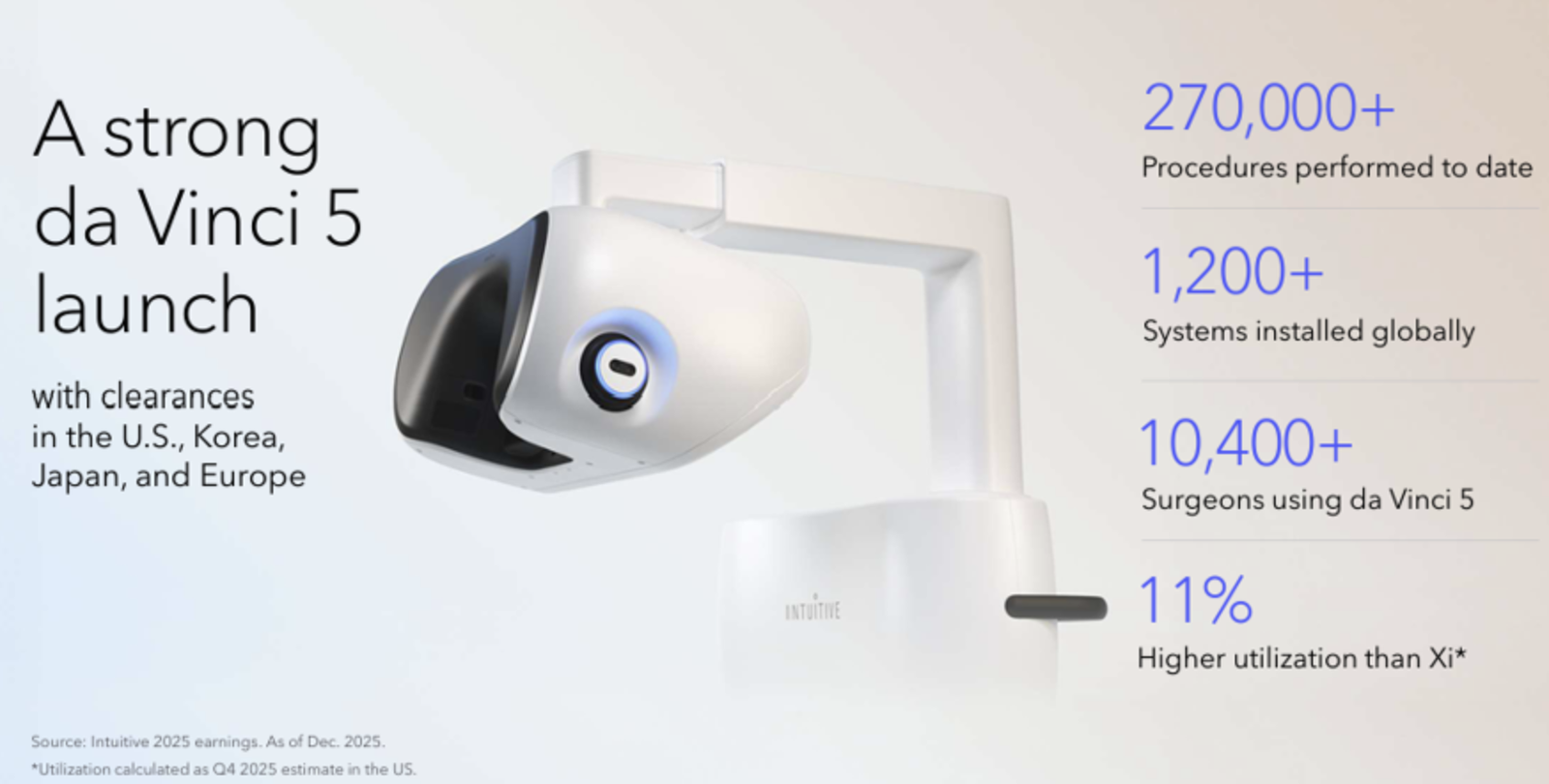
The 5th gen multi port platform (launched 2024), built to upgrade the installed Xi base (rather than open a new use case). It does the same procedure types as Multi port, but with force feedback (haptics), higher res imaging, and more onboard compute for case analytics. It matters less as a new product category and more as proof Intuitive can keep extending its moat through a hardware upgrade cycle, not just the install base growth alone. It's too new for a multi year trend, but the early numbers are strong. As of December 2025, 270k procedures performed, 1,200 systems installed, and over 10,400 surgeons trained, with utilization already running 11% ahead of the Xi system it's replacing.
Da Vinci SP - smallest base, fastest growth:
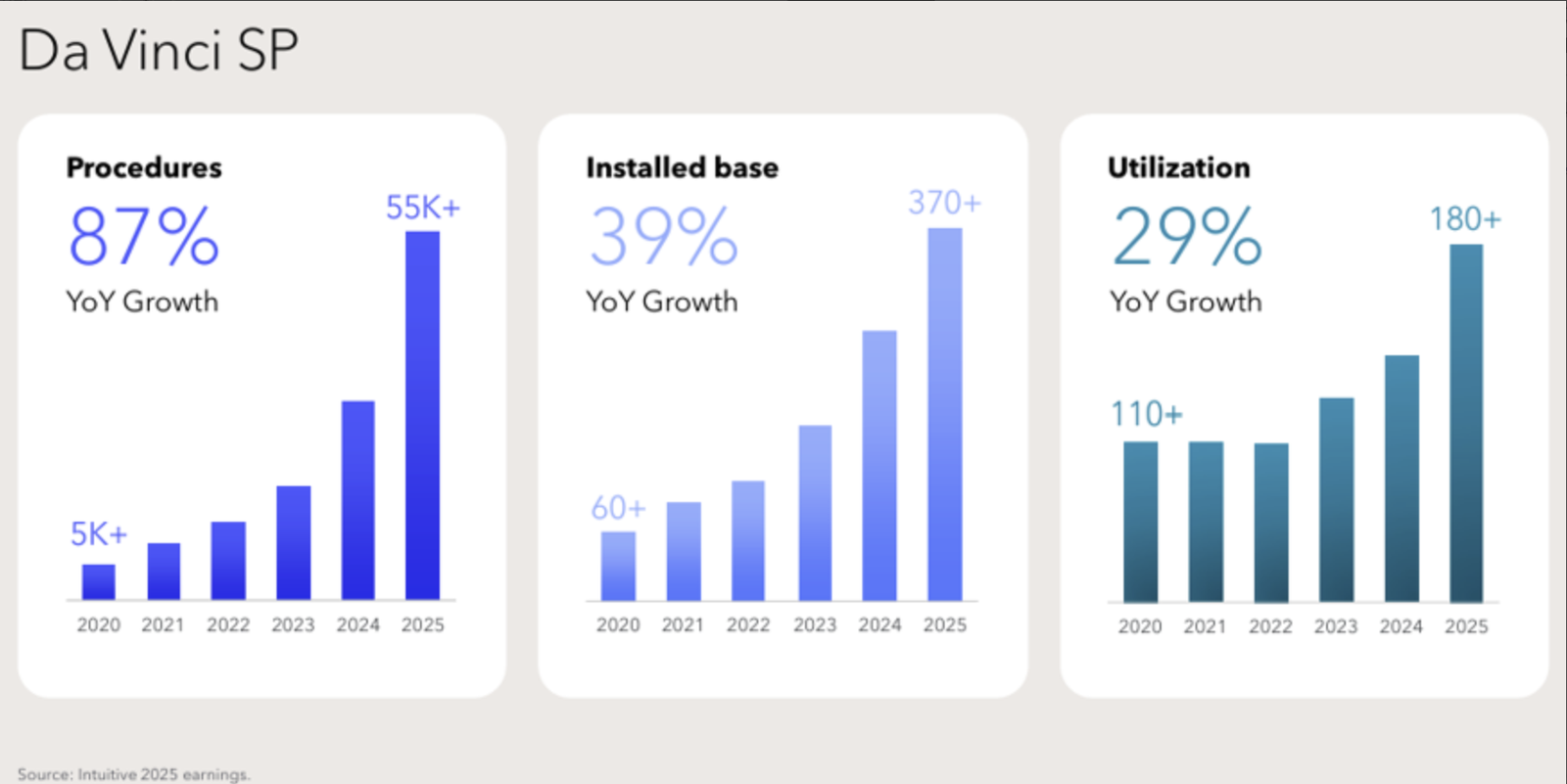
SP (Single port) trades multiple robotic arms for just one. the entire system enters through a single small incision, which matters for procedures where multiple ports aren't practical (transoral (head & neck) surgery, transanal surgery, and single-site urology). It's a genuinely different addressable market from Multi port, not just a smaller version of it, and it's the platform with the steepest long term trajectory. since 2020, procedures have compounded at roughly 60% per year (5K to 55k in 2025), installed base at roughly 44% (60 to 370), and utilization at roughly 10% (110 to 180). Those rates will naturally decelerate as the base scales, but they say a lot about how early SP still is in its adoption curve relative to Multi port.
Ion - the adjacent expansion platform:
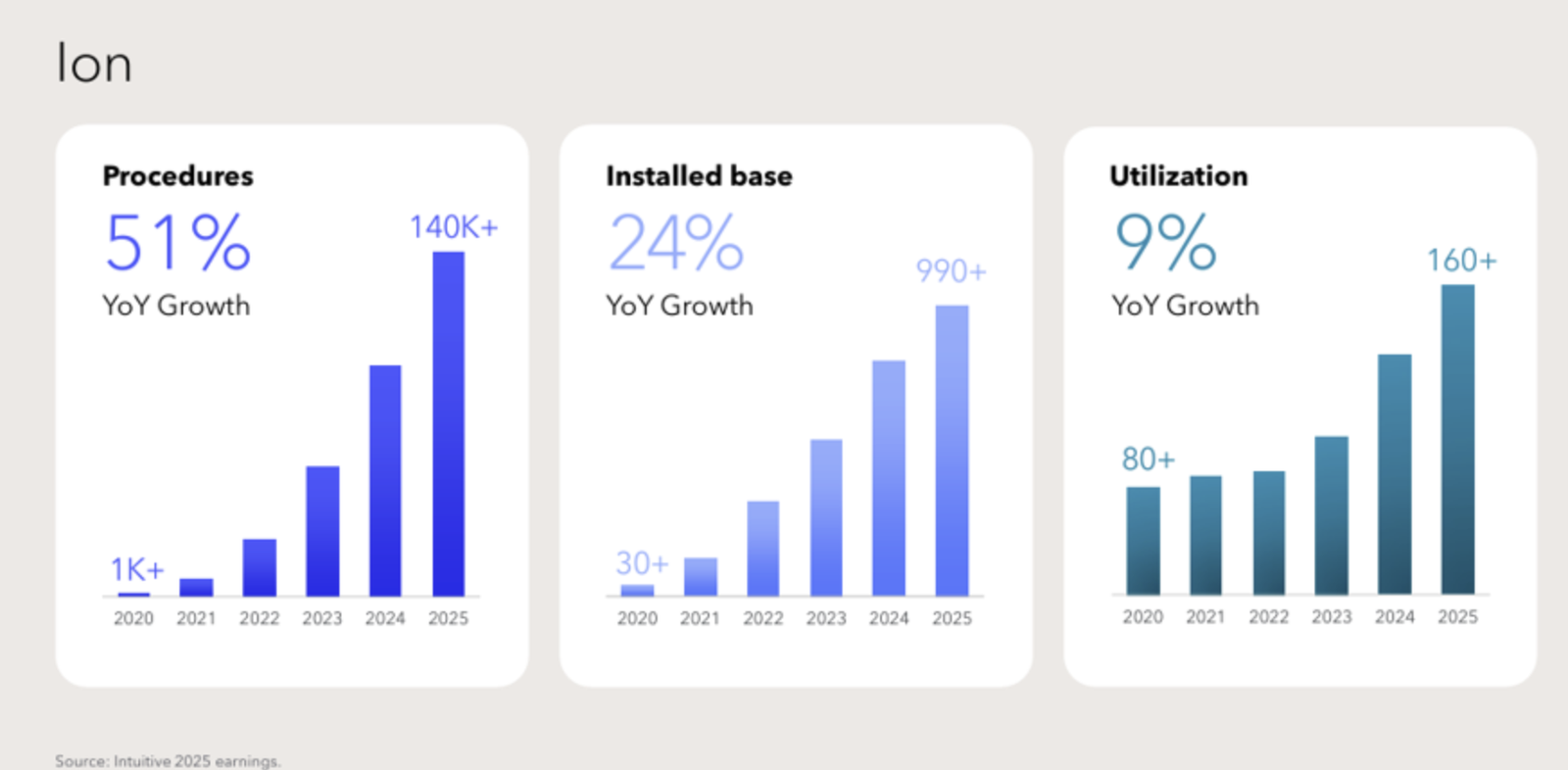
A completely different device from the Da Vinci line: a flexible, robotically steered bronchoscope that navigates deep into the lung's smallest peripheral airways to biopsy nodules that are otherwise hard to reach, aimed at catching lung cancer earlier. It's Intuitive's first real move into a diagnostic procedure and a new disease state (pulmonology) rather than an extension of its surgical franchise. The growth is impressive… Since 2020, procedures are up roughly 140x (1K to 140k in 2025, a 169% CAGR), installed base up roughly 33x (30 to 990 equating to a 101% CAGR), and utilization up 2x (80 to 160). Those triple-digit rates say more about the near zero 2020 starting point than a sustainable steady state pace, but even a meaningful deceleration from here would still make Ion the fastest growing thing in the portfolio for years.
Put it all together and Intuitive had 11,710 systems installed worldwide as of June 30, 2026 (6,615 in the US, 2,325 in Europe, 2,111 in Asia, and 659 in the rest of the world).
Management's stated 2026 priorities are pretty straightforward. Keep growing the platform footprint, drive procedure adoption per system, scale manufacturing and quality, and keep pushing R&D into new disease states. It's a continuation of the same playbook that's been compounding for 2+ decades.
Industry Backdrop - Why These Growth and Margin Numbers Are Plausible:
Before trusting my own growth and margin assumptions, it's worth grounding them in what's actually happening in the underlying market and in what Intuitive itself is guiding.
After Intuitive acquired its only real rival, Computer Motion (maker of the ZEUS system), in 2003, there was no other FDA cleared soft tissue surgical robot on the market for roughly the next 15+ years. So, historically, Intuitive’s soft tissue market share share has remained close to 100%. Going forward, we will need to account for a more competitive environment with for new entrants such as J&J with their newly authorized Ottava system,
Industry analysis is a pretty mixed bag, but I was able to come up with an average surgical robotics industry size of about $12.5bn. This equates to Intuit having a roughly 80% industry market share. Industry growth expectations all sit within a 14.5% to 17% range to the mid 2030's. using a 16% industry CAGR, this means we are assuming an industry size of $55.14Bn by FY35). If we rightfully assume the average growth will tilt high in the earlier years we can assume growth shelves of a 19% CAGR from 2025 to 2028 (21b),16% CAGR from 2028 to 2032 (38b), with the industry growth rate falling to about 13.2% from 2032 to 2035 to hit the industry target of $55.14b by 2035.
This represents Intuitive's market share falling by about 10 percentage points over the deliberate forecast period.
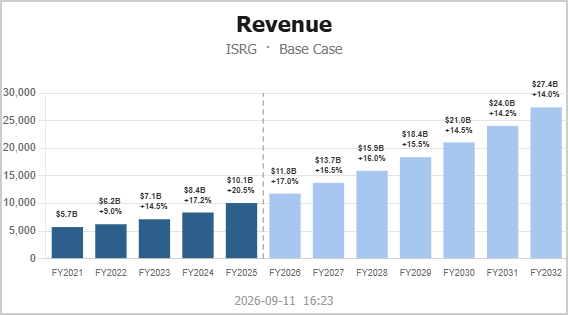
Management is guiding for procedure growth of about 15% for the fiscal year of 2026. With a continuation of the upgrade cycle to da Vinci 5, I make the argument that 17% revenue growth (tapering down to 14% by FY32) is sustainable.
Structural Drivers and Guidance:
Two forces sit behind the market growth. First, an aging population is generating more surgical volume across the procedure types Da Vinci and Ion already address. Second (and more important for the growth runway thesis) robotic assistance is still a minority of eligible procedures, not a mature technology. One estimate put robotic assisted surgery at just over 15% of general surgeries in 2023, with adoption projected to roughly double within five years.
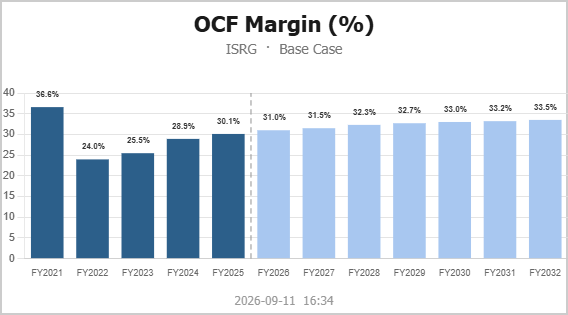
The margin case doesn't need to lean on hope either. Instruments, accessories, and service already make up roughly 75% of revenue, and that mix grows as a maturing installed base runs more procedures per system without a proportional rise in R&D, manufacturing, or SG&A and it's already showing up in the reported numbers. Intuitive's Q2 2026 non GAAP operating margin was 42.1% and full year 2026 guidance calls for a 68% non GAAP gross margin (which already bakes in an estimated 1 point drag from tariffs). My base case's OCF margin path (30% to 33.5%) sits well below that reported operating margin on purpose. It's a more conservative cash flow basis figure that follows the upward trend driven by a larger share of revenue coming from those instrument/accessory/services segments while remaining below peak OCF margins.
What The Model Says:
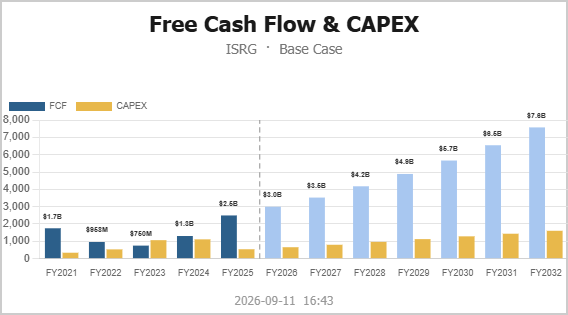
Should CAPEX as a % of revenue normalize at about 17.5% to 18%, we could see Free cash flow of $7.5b by FY32.
Running these assumptions through my model, I get a an output that points to a very high quality company trading at a 15% discount to intrinsic Value, representing short term low double digit IRR's and long term high single digit IRR's.
Against my own entry criteria (20%+ discount to intrinsic value, 10%+ IRR ), this mostly clears my requirements .the IRR bar clears it comfortably (over the short term) and sits just under my usual discount threshold. That's a close, but not automatic signal for me. It's not a screaming buy on valuation alone, but Intuitive Surgical is a business I'd be comfortable owning at a smaller discount given the moat quality and growth runway.
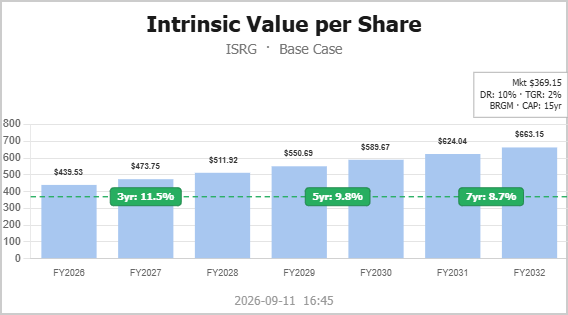
I initiated an entry position at about $376 per share. I am personally quite excited about this opportunity with the understanding that the stock can (and likely will) continue to fall. Should we see a further 20% drop, I am happy to increase the size of my position.
**As always, this is not investment advice. Do your own research and come to your own conclusions**
Thoughts?
Equity forge is still private (so comments on this article are not possible - as of today) but If you have any thoughts, I would love to hear from you! You can reach out by sending me an email at:
ryley@equityforge.ca