Was I Wrong to invest? I do not Believe so...
Lululemon just released their Q2 results and the market was less than impressed. Guidance cuts and an overly pessimistic tone called for a revisit of our DCF model on the company.
As mentioned in my June article, I believe that the brand is experiencing a moment that looks very similar to Aritzia’s 2023 slump, which was defined by a period of stale product, weakened brand energy, and a consumer base that felt they already owned everything. Aritzia recovered through a product and brand refresh, and if management is able to execute, Lululemon is well positioned to do the same.
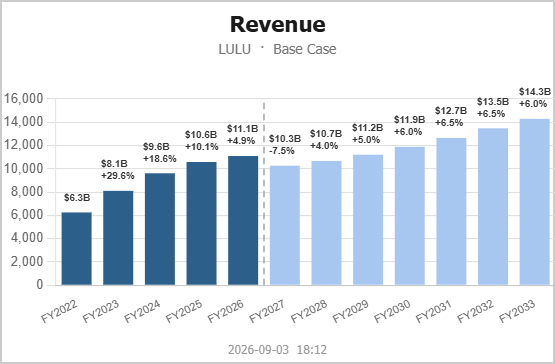
My model indicated FY27 growth of 5% (indicating revenue of $11.7B). Management has since revised their outlook down to $10.35B - $10.5B. I have amended my model to indicate growth below the lower end of their guidance, equating to a decline of -7.5%.
To account for a more competitive environment, I do not forecast revenue getting back to its FY26 high until FY29, at which point I believe the company can sustain mid single digit growth for the discretionary forecast period.
Heidi O’Neill and Why She Matters:
The hyper growth stage is over, but I believe that once Lululemon refreshes its lineup (under the leadership of Heidi O’Neill), the company should be able to grow as a durable mid single digit compounder.
She has a strong track record as a product‑first operator with 20+ years at Nike, where she played a pivotal role in women’s sportswear, product pipeline development, and brand voice. Lululemon fell asleep at the wheel, but if anyone is able to get the brand back on track, it will be Heidi.
Heidi’s first day will be September 8th, and it is from that point forward that I will judge management’s execution.
Competition & Margins
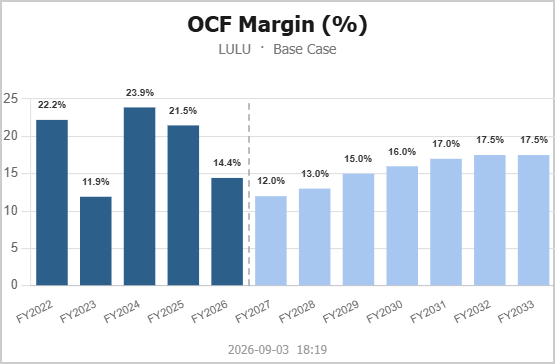
Q2 was undeniably weak. Management cut revenue guidance, and the results make it clear that Lululemon will need to spend more aggressively to refresh its product lineup and defend its position in an increasingly competitive market. To reflect this, I have revised my operating cash flow (OCF) margin assumptions downward.
I previously modeled FY27 OCF margins at 15%, but given the higher investment required to rebuild product excitement, I now forecast 12%. This reflects both the near term costs of a product refresh and the reality that competition from Alo, Vuori, Nike Women’s, and other emerging brands will limit full price sell through and require elevated marketing and innovation spend.
Long term, I still taper OCF margins back to 17.5%, which is well below the 22 - 24% Lululemon achieved in prior years. This more conservative margin profile accounts for a multi year period of elevated expenses as the company rebuilds brand energy and modernizes its assortment. Once the refresh is complete, margins should normalize in the mid to high teens (a level that still supports meaningful free cash flow generation and long term compounding).
Looking Forward - Intrinsic Value Calculation
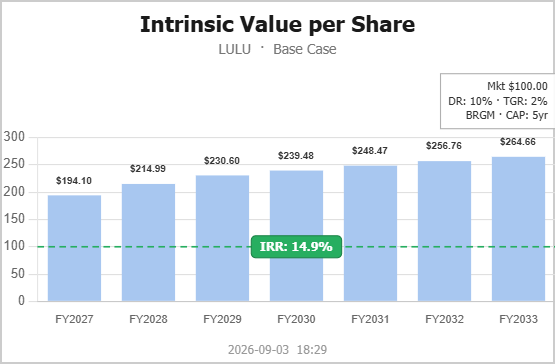
If you believe Lululemon’s issues are rooted in product fatigue rather than structural decline, then the recent 18% drop to roughly $100/share represents meaningful long term value. The company does not need to return to double digit growth or recapture peak margins to justify today’s valuation. It simply needs to stabilize, refresh its product pipeline, and resume mid single digit compounding.
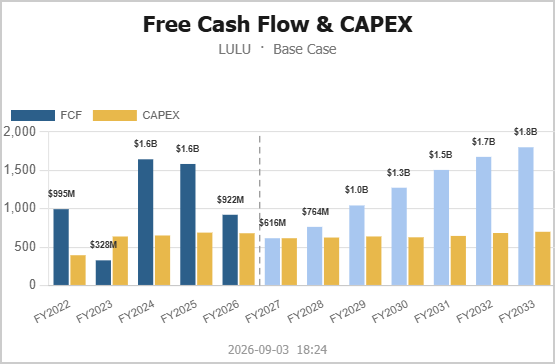
In my model, free cash flow does not recover its FY24 peak until FY31, reflecting both the slower revenue trajectory and the higher investment required for a product refresh. Yet because the stock has been punished so severely (and rightfully so) the long term valuation gap has widened. Even under conservative assumptions, I estimate that Lululemon is over 48% undervalued at $100/share, with a 5 year IRR of about 20%.
The market is pricing in structural deterioration. I see a cyclical, product driven slump with a credible path to recovery under new leadership.
I was buying at $115 when I published my first article, and I will be buying more at market open tomorrow.